
Holders of the NLP Master Practitioner level (if you are currently studying toward this certificate, you can apply).


Grow your ability to accompany experiences that are hard to talk about.
An NLP specialization in working with trauma: deepen your understanding of overwhelm, freezing and past experiences, and learn ways of guiding that respect the pace of the person in front of you.
For holders of the NLP Master Practitioner level. Those currently studying toward this level may also apply.
Registration for the cohort is currently closed. You can start with the intro session.
Join the free intro sessionThe events of October 7, 2023 shook all of us profoundly. We have been through, and are still going through, a very challenging period marked by sadness, loss and national mourning.
In coping with difficult events, facilitators encounter questions of loss, anxiety, overwhelm and past experiences.
In addition, so many people came to these events carrying an earlier trauma: sexual abuse, a difficult childhood, an accident, a life-threatening illness, a previous war, bereavement, divorce, financial survival and the like.
The specialization is designed to deepen your familiarity with trauma and to teach how to adapt facilitation tools for people who have experienced it.
Experience facilitating support groups for survivors of the Nova festival
Following the events of October 7, Retter College ran rehabilitation and support groups for survivors of the Nova music festival. The groups used the NLP processes taught in the specialization.

Working with trauma requires preparation, sensitivity and professional guidance.
In the specialization we will make room both for the processes themselves and for the questions that arise while facilitating:
how to build trust, how to relate to the difficulty that surfaces, and how to adapt the work to the client's pace.
For all these reasons, this year we chose to offer the trauma specialization
to a large group of NLP facilitators – to make it easier for as many talented facilitators as possible to join the circle of supporters, to break out of helplessness and to treat.
Amir Retter, the specialization's instructor,
shares from his experience on the effectiveness of NLP in treating trauma:
In working with trauma, choosing the process is only part of the session. It calls for attention to trust, to the sense of safety and to the pace at which the person in front of you can take part in the facilitation. In the specialization we learn to attend to all of these alongside practicing the tools.
Difficult past experiences may surface even when the original purpose of the session was something else. The specialization addresses the questions they raise and ways of working with the client.
So if you work with people, it is important to have tools for handling the situations and challenges you may encounter, both in sessions with clients and in encounters with people outside therapy (family, friends, and even yourselves).

For facilitators who want to focus on the subject, the specialization offers study of dedicated processes, practice and a professional supervision group.
Experience in facilitating NLP is a starting point, but working with trauma requires further depth. We will learn about building connection, listening and coping with overwhelm, and examine how to choose a process according to the needs that arise in the session.
Throughout the studies we will connect the processes with practice, questions and professional guidance.

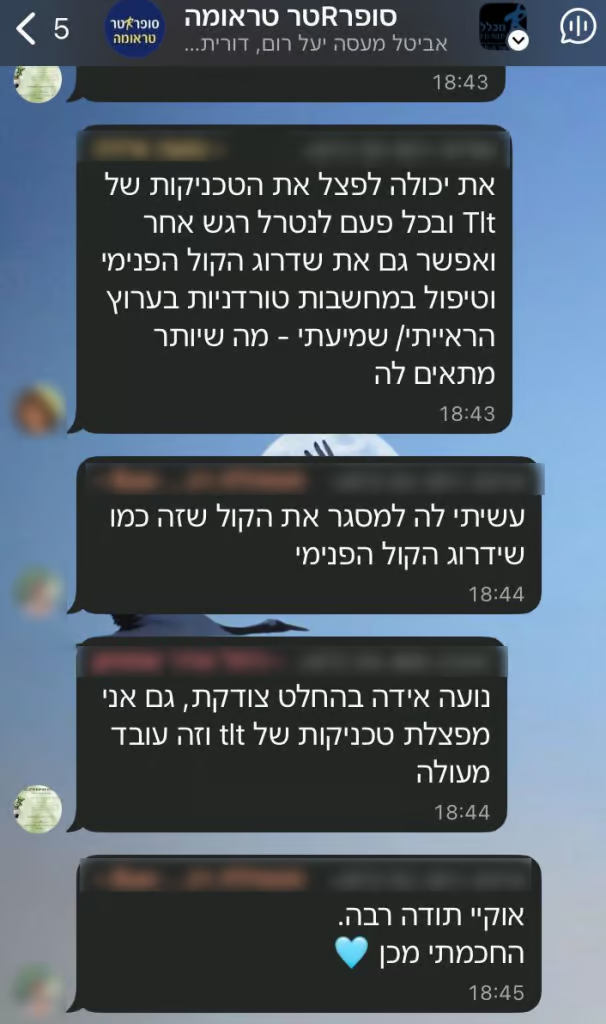
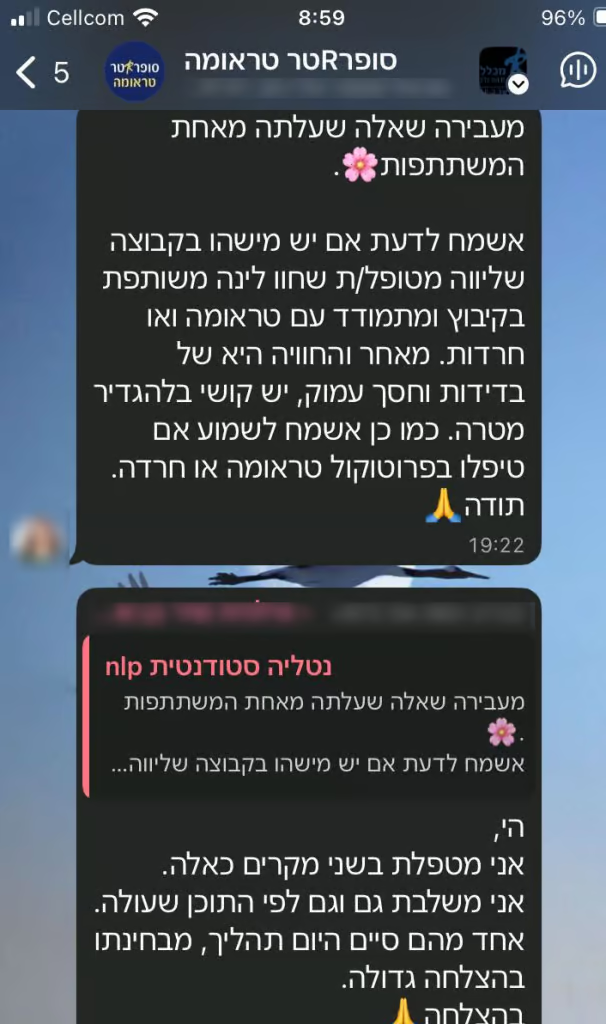
Holders of the NLP Master Practitioner level (if you are currently studying toward this certificate, you can apply).

Therapists, facilitators and coaches in NLP and guided imagery who meet the admission requirements and want to focus on working with people who have experienced trauma.

Therapists and NLP graduates who want to treat events from their own past, strengthen their self-confidence and broaden their ability to touch on complex subjects, both with themselves and with those close to them.
* Assistants and trainers who have not yet used the benefit they are entitled to are welcome to register and pay only half price.

Amir Retter
Holds the ranks of NLP Master Trainer, NLP New Code Trainer (certified directly by Prof. John Grinder) and Time Line Therapy™ Master Trainer (certified by Tad James). Coordinates the study tracks in the two-year program. Holds a degree in electronics engineering. Since 1994, Amir has treated thousands of people who suffered functional and emotional harm following trauma, with impressive success. Amir is gifted with a unique sensitivity, compassion and capacity to contain, which he will teach you in this important specialization.
How to create a safe and protected environment, and how to enable the client to feel the courage and capability to face the traumatic memories. In this session we will also learn foundational concepts. The process in this session is inspired by Professor Mooli Lahad.
A process created by the psychologist and NLP facilitator Dr. Stephen Gilligan, which uses the image of a protective layer. In this session we will also learn the principles of working with trauma.
A process by Michael Carroll for working with the way the traumatic event is experienced in memory. In this session we will also learn about the symptoms of PTSD.
Two processes created by Michael Carroll: the first deals with an anchor of safety, and the second with working with the traumatic memory on the time line.
A process created by Professor John Grinder following his work with combat-stress veterans after the Vietnam War.
A process created by Connirae and Steve Andreas. The aim of the process is to restore the continuity of memory that was broken by the trauma, and to connect the event in a balanced way to the continuum of life.
Another process by Connirae and Steve Andreas. The aim of the process is to help clients who have experienced loss.
A process created by Daphna and Amir Retter for working with the sensory components of the memory and with the experience of overwhelm.
A process by Connirae and Steve Andreas that uses the ability to move between association and dissociation, and teaches the subconscious to stay automatically dissociated from everything related to the traumatic memory.
A process created by Daphna Retter to treat flashbacks – those tormenting flashes of memory that severely damage the quality of life of people with PTSD – and to reprogram them using a swish.
Another process by Daphna Retter. Humor is a powerful tool for getting people to step outside themselves and look at the situation from a distance. With an auditory swish, the memory can be reprogrammed.
A process created by Michael Hall. A closing process that brings the client to a state of acceptance and self-compassion. In this session we will build a detailed protocol for treating post-trauma and wrap up the entire specialization.
 90% attendanceInternshipNLP Master Practitioner level
"The specialization shed a lot of light on dark places. I understood that trauma cannot be erased, but it can be given a new meaning"
"The trauma studies helped me approach this very frightening subject with confidence"
"I recommend taking the course and learning the techniques that help clients come out of the trauma, and not only out of the symptom"
"The course gives a great deal of hope and optimism about helping to treat trauma victims"
For holders of the NLP Master Practitioner level. Those currently studying toward this level may also apply.
Until registration opens, the intro session lets you get to know the program and see whether it is right for you.
You can get to know the program before deciding how to continue.
Ⓒ Retter College. All rights reserved.Privacy policyAccessibility statement