Israel's first NLP college
Retter College was founded in 1994 and is the
first college in Israel for NLP studies.
Daphna and Amir Retter brought NLP to Israel and made “spreading the word” their life's work, which they have focused on ever since.

A prestigious training program that distills 30 years of experience into one integrated, multi-level track.
From the very first step to advanced clinical skill –
Israel's most comprehensive program, for beginners and continuing students alike.
Whether you are taking your first steps or aiming for a profession…
Retter College's complete track is the full answer for you.
Before we talk about the syllabus,
ask yourself
Our graduates chose not to settle for their natural talent alone, but to give it a stable professional foundation. We invite you to join the institution that founded the field in Israel, and to turn your aspiration to help people into a meaningful, prestigious and rewarding career:

Just before we introduce Retter's NLP Master program, combined with guided imagery
Since we deeply respect your time and ours,
we also want to be clear about who our program is less suited for.
Our program is not suited to those who
Want to develop real expertise in an in-depth program? Excellent!
Once you leave your details, we will get back to you with all the information about the introductory lesson on the method
Retter College was founded in 1994 and is the
first college in Israel for NLP studies.
Daphna and Amir Retter brought NLP to Israel and made “spreading the word” their life's work, which they have focused on ever since.
NLP studies combined with guided imagery are the purpose and essence of the college, and we do not teach a single course from any other field. The expertise we have gathered, developed and refined over three decades is training people to become outstanding NLP facilitators.

Anyone who wants to get to know NLP and change their own life, and then take the next step – turning NLP into a profession, opening a clinic and creating meaningful change in others – will find the most comprehensive, in-depth and practical training in Israel at Retter College.

To date we have trained more than 6,000 Masters (NLP facilitators) and 573 Trainers (NLP teachers). And more than that: most of Israel's leading NLP professionals, whether NLP is their main or a secondary career – you may even have heard or seen some of them – studied at Retter College.
Studying at Retter College is not only deeper than any other program: it is also experiential, enjoyable and above all exceptionally practical, thanks to a complete, comprehensive learning framework that includes:

As part of the training, every participant goes through a personal, in-depth process. Advanced NLP studies give them the ability to free themselves once and for all from behavior patterns, harmful habits, limiting beliefs, inhibiting blocks or destructive addictions.
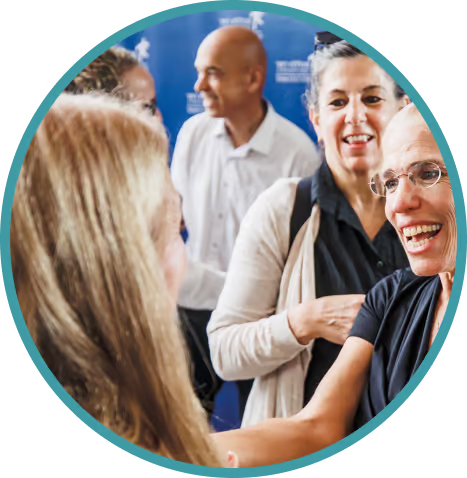
Studying at Retter means joining a family and a warm community that welcomes you with open arms. How many chances do we get to find kindred spirits for life?
Our graduates are in demand at many workplaces, and our certificates are highly prestigious and respected at every NLP institution in the world. Successfully completing your studies at the college grants an international certification to practice NLP facilitation:
If you've made it this far,
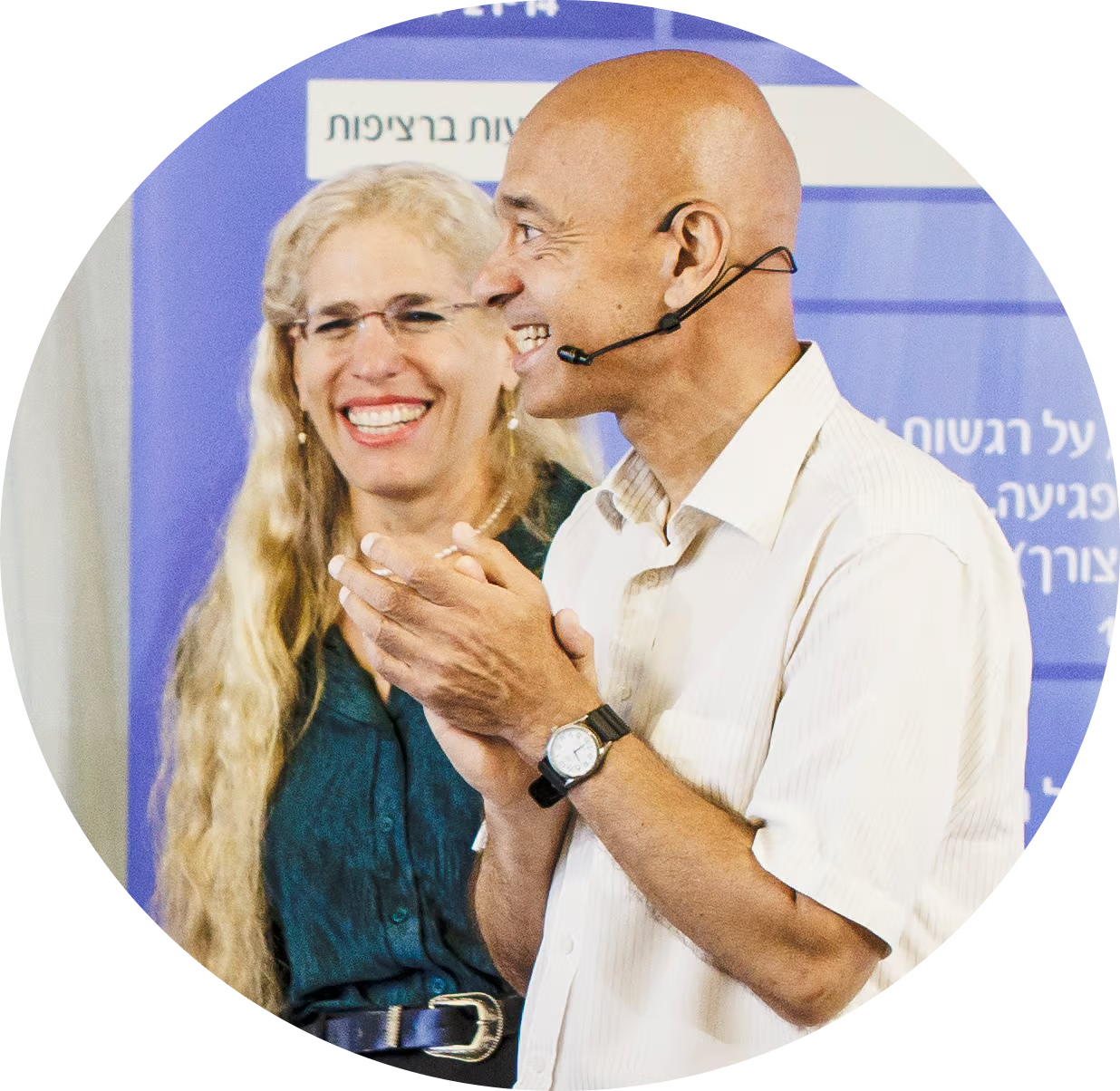
we would like to invite you to meet Daphna or Amir Retter
Until now, you have only read about NLP…
Now we want to invite you to experience this wonderful world for yourself,
to ask us any question and to hear all the details about our training program.
It happens at an NLP Taster – a free, experiential Zoom lesson with Daphna or Amir Retter.

Since the number of places is limited, and so that we can reserve the date that suits you,
all that is left is to leave your name and phone number, and one of our study advisors will contact you.
Our facilitator training follows a highly structured, systematic and clear methodology. The first stage is the NLP Practitioner course, which includes a wide range of everyday tools and practical techniques that make it possible to create noticeable changes in every area of life in a short time.

At this stage we will learn, among other things:
Lesson 1: NLP communication in everyday life – how to turn routine conversations into deep, influential and constructive connection. We will learn a unique technique for creating “rapport” (chemistry) that lets the client feel safe, understood and ready to share. This is the foundation of all therapeutic work.
Lesson 2: NLP presuppositions – we will learn the assumptions on which the NLP approach is based. We will learn to make an accurate, simple assessment of the client's beliefs and values, and to create deep change through language.
Lesson 3: The Circle of Experience (behavior, emotions and thoughts) – an integrated wheel that serves as the foundation of the entire session. This is a new Retter model that gives an accurate explanation of people's beliefs and emotional systems.
Lesson 4: Defining the goal and outcome – we will learn how to translate the client's wish into a well-defined, powerful goal. We will learn to examine the goal from an ecological standpoint, to ensure that the change brings overall improvement and does not harm other areas of life.
Lesson 5: Emotional state, ecology and resources – we will learn to manage our own emotional state and the client's. We will learn to assess the client's system of beliefs and values and to understand which “resource” they lack in order to achieve their goal.
Lesson 6: First practice with the questions – we will practice NLP's key questions and learn to create an emotional scale that makes it possible to measure the change.
Lesson 7: The Anchor – a powerful key to motivating people toward change and to assessing relationships. We will learn a unique technique for creating an “anchor” (linking a stimulus to an emotion) to dissolve limiting beliefs and replace them with empowering ones.
Lesson 8: The Chomsky and Erickson models – understanding the depths of human information processing and their effect on communication.
Lesson 9: Creating guided imagery – we will learn to listen to our client and tailor the most precise and effective image for them to create change.
Lesson 10: The Meta Model – we will learn how to ask the most constructive, surprising and right questions for every situation, and how to unravel blocks in language.
Lesson 11: Shifting positions to change the emotional state – we will learn a unique technique for changing emotions and coping with emotional overwhelm (state management).
Lesson 12: Three Positions – a must-have tool for changing relationships and resolving conflicts. We will learn to adopt different points of view in order to reach deep understanding, forgiveness and change.
Lesson 13: A technique for healing deep fears – we will learn the Fast Phobia Cure, which enables quick, effective release from severe fears.
Lesson 14: Working on the Time Line – we will learn to locate events within past memories and use the client's resources to create repair and forgiveness (the Hindsight Exercise).
Lesson 15: Re-imprinting – we will go deep into the roots of the trauma on the Time Line and enable the client to make a correction and reach a place of compassion and forgiveness.
Lesson 16: Working with children in NLP – we will learn to adapt NLP techniques to the world of children through games and guided imagery.
Lesson 17: Resolving conflicts between parts of the personality – we will learn to create cooperation between different “parts” within us that keep us from moving forward (Visual Squash).
Lesson 18: Releasing automatic behaviors through the Swish Pattern – we will learn a fast, surprising technique for changing habits, fears and unwanted behaviors.
Lesson 19: Language patterns for persuasion and influence – we will learn Milton Erickson's most powerful language patterns (the Milton Model), to create positive influence, release resistance and build motivation.
Lesson 20: Patterns through the use of language – we will learn to use language consciously and flexibly in order to create deep change in the client's beliefs and values.
Lesson 21: Working with emotions through eye movements (Eye Patterns) – we will learn a fast, effective technique for changing emotional states through eye movements.
Lesson 22: Working with deep emotions – we will learn to deal with difficult emotions such as fear, anger, sadness and guilt, and to create deep change through language.
Lesson 23: Working through deep structure – we will learn to listen for the deeper meaning hiding behind the client's words, and to create deep change through metaphors and images.
Lesson 24: Releasing emotions through metaphors – we will learn to create metaphors and guided images that allow the client to release difficult emotions and create deep change.
Lessons 25–26: Summary practice of all stages of treatment – we will practice all the stages of treatment by working with clients.
Lesson 27: A professional working day – we will learn the professional tools needed to open a successful clinic, and learn to manage our own emotional state and the client's.
Lesson 28: Certification celebration – we will celebrate the end of the Practitioner track and hand out certificates.
The second stage of the training is the NLP Master Practitioner course. Over the course of your studies you practice facilitating one-on-one processes and become a certified facilitator. Every therapist who completes the track receives a prestigious international certificate.
At this stage we will learn, among other things:
Lesson 1: Activity and passivity in interpersonal relationships – a powerful key to motivating people toward change and to assessing relationships.
Lesson 2: The Chomsky and Erickson models and creating guided imagery – understanding the depths of human information processing. We will learn to listen to our client and tailor the most precise image for them.
Lesson 3: The Meta Model (the linguistic model) – we will learn how to ask the most constructive, surprising and right questions for every situation. We will practice this in triads.
Lesson 4: “Changing history for the in-between state” – we will learn how to reach the root of the problem the client is facing, connect them there with their own strengths, and arrive at healing.
Lesson 5: “Re-imprinting” on the Time Line – we will go deep into the roots of the trauma and enable the client to make a correction there and reach a place of forgiveness and compassion toward themselves and toward whoever was significant in the event.
Lesson 6: The facilitator-client relationship and professional ethics – we will clarify our professional boundaries and how a facilitator should conduct themselves, and we will sign the code of ethics of the Israeli NLP Chamber.
Lesson 7: Past-life regression – to stimulate the surfacing of projective content. We will learn how the ability to imagine other lives lets the subconscious bring up meaningful content for healing.
Lesson 8: The principles of encouragement and an observation exercise – how to empower others and give them growth-oriented feedback. We will begin an “observation exercise” that will accompany the course and let every participant demonstrate their clinical skills.
Lesson 9: Introduction to Meta Programs (the NLP profile) and levels of abstraction – we will learn a 14-item model that boosts communication ability, and see how significant it is to know how to move between abstract and detailed speech.
Lesson 10: The “Chairs exercise” – we will learn an NLP process inspired by the Gestalt approach, a process with the power to bridge inner gaps and lead people to make a desired change.
Lesson 11: What are our values? – we will learn to identify values and understand this fascinating subject. We will learn about the values we aspire to versus those we want to avoid.
Lesson 12: “Redefining a value” – a process for behavioral change based on modeling. We will learn that change is possible if we know how to learn from others, and from ourselves, in the right way.
Lesson 13: Strategies and modeling – we will understand how we operate and what moves us forward. We will learn how the ability to model successful people is a highly effective key to success.
Lesson 14: Meeting the inner child – we will learn a moving guided imagery that brings us face to face with our childhood and allows healing of past wounds.
Lesson 15: Are comparisons helpful or hindering? – we will learn types of comparisons, communication assessment, and motivating words (choice versus coercion) that can awaken dormant motivation.
Lesson 16: “Changing a value hierarchy” – our values are usually arranged unconsciously. We will learn a process for arranging our values better in order to achieve the changes we want.
Lesson 17: Building and changing beliefs – how can we change beliefs when they weaken us? We will learn a wonderful, pleasant process for changing beliefs: Robert Dilts's “Resonance.”
Lesson 18: Personal conversations and peer facilitation – we will devote an entire session to personal conversations between participants and the course facilitator, alongside supervision circles led by the assistants.
Lesson 19: “Changing beliefs with symbols” – we will learn a process that draws on symbols arising from the subconscious. We will weave these symbols into a guided imagery unique to the client.
Lesson 20: “Changing the belief cycle” – we will learn to change beliefs by modeling the natural cycle through which our beliefs change.
Lesson 21: Changing emotions and overwhelm – how do you cope with emotional overwhelm? We will learn a unique technique for changing deep emotions.
Lesson 22: Treating phobia – we will learn a simple, surprising and extremely effective process for quick release from phobias (of flying, heights, elevators, animals and more).
Lesson 23: Chaining anchors – a wonderful process for changing the inner autopilot, creating a constructive path that leads to the desired change and to the release of deep blocks.
Lesson 24: Walt Disney – who doesn't know Walt Disney? We will learn about the strategy he used to succeed so greatly, and discover that we, too, can apply it in our own lives.
Lesson 25: Verbal agility, marketing and sales – practical tools and quick thinking for filling your clinic and for professional success the day after.
Lesson 26: Initial screening and the SCORE model – we will learn the SCORE model and the SCORE dance for accurately assessing every problem and goal.
Lesson 27: The future in steps – a powerful technique suited to concluding NLP processes, together with the participants' personal presentations.
Lesson 28: Final exam and conclusion – after a multiple-choice exam that tests command of the material, we will hold a moving activity to close the certification.
Four full study days: a seminar for all students at the Master level, given to you as a bonus by the college. We will learn a complete, deep and unmatched therapeutic tool for releasing negative emotions and limiting beliefs from the past.
The first stage of NLP studies, at the Practitioner level, focuses on 2 areas:
The study framework includes:
The course provides many tools for working with others, and just a few weeks into the studies we begin practicing the NLP tools we have learned in one-on-one sessions outside course hours.
Sessions are conducted under oversight, professional consultation and personal mentoring (supervision).

28 weekly sessions or 14 intensive study days
240 academic study hours, divided as follows:
168 in-person/Zoom hours
60 practice hours / private breakout rooms on Zoom
12 hours of the NLP New Code seminar
The second stage of the training, at the Master Practitioner level, focuses on advanced NLP processes and is divided as follows:
The study framework includes:
296 academic study hours, divided as follows:
168 in-person / Zoom hours
80 practice hours / private breakout rooms on Zoom
48 hours in the “Time Line Therapy” seminar
* To absorb the course material well, keep in mind that practice time beyond the study hours is required.
At Retter you can study almost anywhere and almost any time. Our goal is to give you maximum convenience and flexibility during your studies and afterward.
We have 12 branches nationwide, from Karmiel in the north to Beer Sheva in the south.
Some courses run in the evening, some in the morning, in intensive study days, on Fridays, and also on Zoom. So if you miss a lesson for any reason, you can always make it up at another branch or on Zoom.

Founder and director of the college (1994). NLP Master Trainer certified by Tad James and John Grinder (ABNLP, IN).

Founder and director of the college (1994), BSW in social work and NLP Master Trainer certified by Tad James, Robert Dilts and John Grinder (ABNLP, NLP University).

The world's youngest Master Trainer (NLPU). Leads the children's specialization.

NLP Certified Trainer, social worker specializing in trauma and stress.
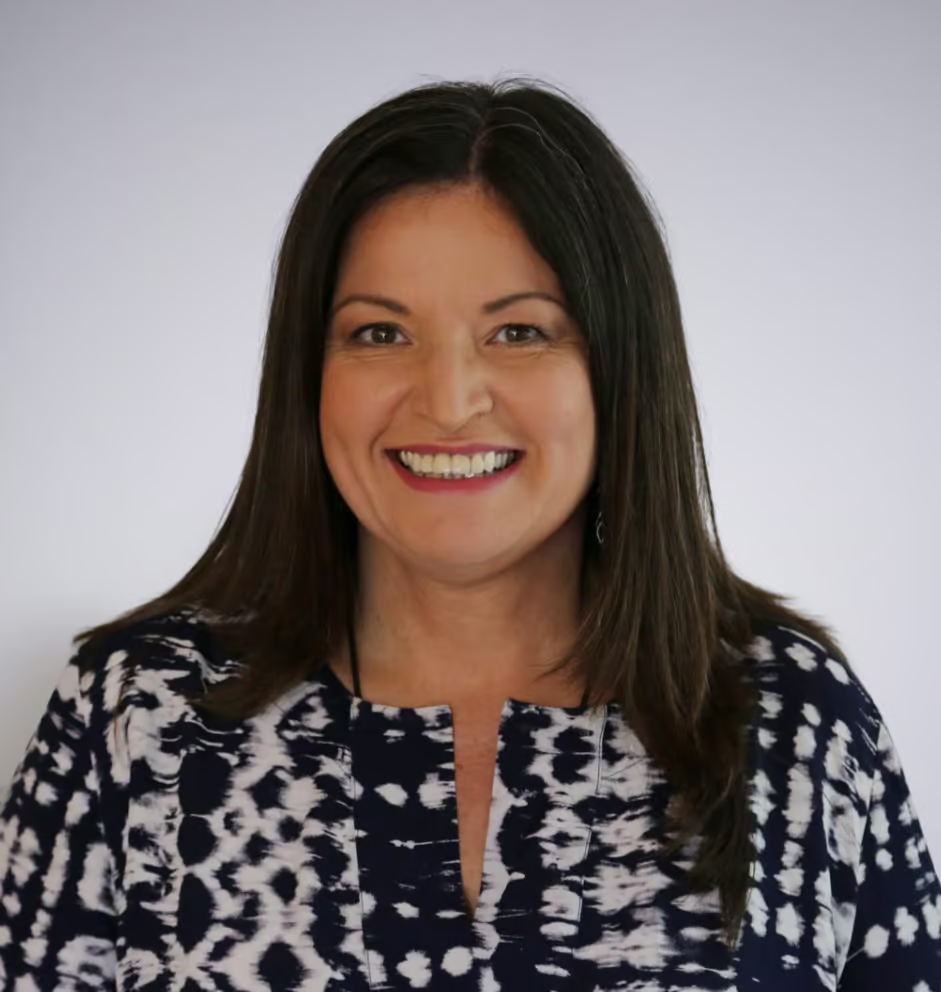
NLP Certified Trainer, psychotherapist specializing in fertility and post-trauma. Lt. Col. (Res.).
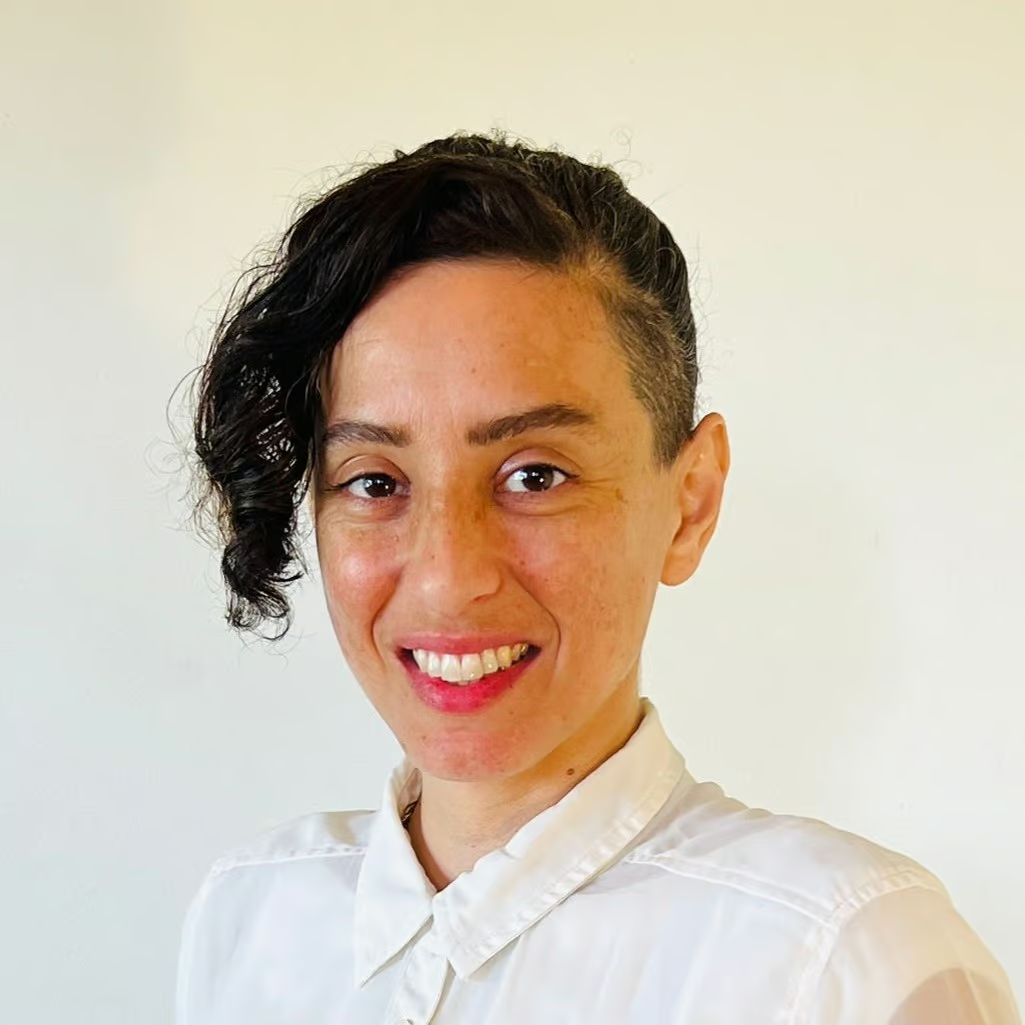
NLP Certified Trainer, facilitator of personal-growth and entrepreneurial-growth groups.

We have answered the most frequently asked questions about NLP Master training for you
(but if you have more questions, you are welcome – and encouraged – to reach out to us)
Absolutely! You can join our NLP Master Practitioner course provided that the institution where you completed your foundation training is officially recognized and certified by the Israeli NLP Chamber. That said, we will share from our experience: many graduates who come to us from other institutions are surprised by the depth, the amount of practice and the unique integration of guided imagery in the Retter method. Many of them choose to study the full training track with us from the very beginning in order to fill in gaps, or continue with us all the way to the summit on our “Stars Track” – to NLP Trainer certification. We would be happy to review your certificate and advise you on the most precise point of entry for you.
Good question. Until COVID, we did not think NLP could be taught remotely; it seemed to us that participants would not be able to be in direct contact with one another. Nor did we imagine a situation in which therapist and client meet in any way other than the one we had known until then – “face to face.”
But the pandemic revealed a new world to us. We discovered that you can treat and teach through Zoom. Here too, people meet, get moved and reach real depths – and all of it remotely.
So, from then until today, we have learned the possibilities this wonderful application offers us: how to facilitate individuals or a group on Zoom, how to maintain interest as well as intimacy.
Yes, Zoom has features that preserve the personal connection. For example, during the studies we divide the participants into “private rooms,” so that each pair or trio enters a private session and practices with maximum intimacy, without the rest of the group present. The course facilitator can enter the private rooms, watch what is happening and help if needed.
Over time we discovered that Zoom has advantages too. Beyond the fact that after graduating it is very easy to find clients who even prefer remote treatment, during the studies themselves it is very easy to keep the classroom quiet, everyone sees everyone's eyes and hears easily, no time is lost on the road or in traffic jams, there is no need for parking and there are no fuel costs. Everyone studies comfortably at home. There are no rental costs, so we even lowered the price of our courses by 10%.
An NLP course on Zoom is not right for everyone. But some people connect wonderfully, and we have found that even those who do not connect at first learn over time to enjoy it.
For some people Zoom is an ideal way to learn: those who live in the periphery or even abroad, those with limited mobility, those with weakened immune systems and more. All of them would prefer the Zoom course at this time.
You have complete freedom of choice. Whoever prefers can study in an in-person course, and others can study on Zoom.
To reach the Master level, you need a strong foundation. A real NLP course cannot come down to a few days. A certificate is important, without a doubt, but it is worth judging its value by three tests: the knowledge it gives, the authority that issues it, and its value on the market. We have been teaching NLP for 30 years, and we offer the full range of certificates, from Practitioner to NLP Trainer.
Behind the certificates lies a great deal of thought, based on our experience with thousands of students. True, we could have given less, putting less emphasis on integration and application. But in practice, what we give is the knowledge without which you cannot really work in NLP and succeed over the long term. It matters to us that everyone who receives a certificate from us knows how to use it to create change, in themselves and in others. Who stands behind the certificate? Retter College is the largest college in Israel, the first to teach NLP in Israel, and is recognized as an institution approved by the prestigious ABNLP to grant an international certificate. Over the years we have built a strong reputation with NLP and guided imagery and become synonymous with the best training in the field. It is a fact that most of those who have worked in the profession over time (the vast majority!) studied with us. Many of our students have told us that they took courses elsewhere and then repeated the course at the college. Shall we let you in on a secret? Most of the teachers at other well-known colleges around the country were trained at Retter. So the certificate that Retter College graduates receive is highly valuable, both in the job market and in practice, in the field.
Every expense deserves thought. That is perfectly clear. On the other hand, if you have truly decided to work with NLP, it is important to remember that, unlike many courses, this is training that will let you earn a living right after you finish your studies. So it will certainly pay for itself, well before other programs. As for price, we are certainly more expensive than most places that teach NLP, but that is only the bottom line and does not reflect what you get for every shekel. If we get into the details, there are many more hours of learning and practice here, and much more experience, which is exactly what is needed. Besides, we have already said that most practitioners in the field studied with us. So yes, there are online NLP courses, even many. Some training is more highly recommended and some less. There are short NLP courses and long ones, with practice and without – there is even a free NLP course! We are sure you can find courses of every kind and variety, but the question is what you gain from the course and what you take with you into the field. For us, your ability to succeed matters above any price.
Retter's in-depth program gives you enough time to go through a truly meaningful process and break through your blocks, while developing the ability to help others. Now, the question we believe is truly important to ask is: what prices have you paid in your life for not managing to make the longed-for change you wanted so much? Not necessarily the price in money. The price of damage to your quality of life, the price of the feeling of missed opportunity, guilt and anxiety – perhaps in the fear of teaching your children bad habits. Or of working in a profession that is not good for you.
Is there really a price on quality of life – on living well with yourself and your family, and teaching your children by personal example the values that matter to you? Is there a cheap or expensive price for your health, whether physical or mental? Is there a cheap or expensive price for the relationships that are good for you? Bottom line – we have no doubt that the money spent on the best study program will pay for itself in a short time.
Alongside the understanding that investing in your quality of life is worth any price, you may still be pleased to discover that there are discounts, benefits and eligibility for tuition reimbursement:
– Studies at Retter College are recognized by the continuing-education fund (keren hishtalmut) for teachers on sabbatical (6–8 weekly hours per course!), the Knowledge Fund for civil servants, mothers whose children attend Tamat daycare centers, vocational training for IDF retirees, the absorption basket and the rehabilitation basket.
– As an additional bonus, we offer a “Refer a Friend” benefit to every student who refers a new student.
Our facilitators are all Retter College graduates with years of experience. We know them personally and in depth, and we choose them carefully. We do not compromise on the quality of facilitation, nor on communication and human relations. We are closely involved in what happens in all the courses, and we personally support and guide our teaching staff throughout the school year, receiving and reading every piece of feedback about them. Our students love the teachers who lead them to success and excellent results. So it is important to us that you trust us on this – we do not skimp and we do not compromise here. It also happens that a student does not connect with the group they signed up for. It is rare, but we are always attentive to it and do whatever is needed so that everyone finds their place in the group. Our advantage as a nationwide college is that about ten courses run simultaneously across the country, so anyone who feels they really cannot connect can move to another group.
In our first years of operation, we also ran short programs. But we quickly realized that to become a professional therapist and earn a valuable NLP Master certificate, a program of just days or weeks is not enough.
In a short course it is simply impossible to convey and absorb all the vast knowledge and skills required. This inevitably undermines the facilitator's confidence and ability to apply the tools in the clinic. We are confident in the results achieved through NLP studies and guided imagery, but to achieve the maximum, we must make sure we have covered everything that is needed.
The comprehensive track lets you experience things in depth, both wearing the facilitator's hat and as the client. During this period you have real time to digest, apply and practice everything, both in the classroom and outside it.
If it matters to you to go through a deep, fundamental personal change that lasts, and at the same time to learn how to pass it on with complete confidence – you have to do it right and thoroughly. What is learned quickly and with shortcuts is usually forgotten just as quickly. Deep learning is what brings fast results that stay forever.
So that you can check right now whether the program suits your expectations,
your needs and your goals –
and so that we can see how well you fit the program –
we invite you to leave your name and phone number
and we will get back to you with all the details about the program, the special intro lesson
and what comes next.