Can online NLP studies replace the classroom experience?
The digital age has opened up learning opportunities without geographic borders, but it also raises questions about the quality of training in the fields of therapy and coaching. Online NLP studies offer an ideal solution for anyone looking for thorough, professional training without giving up the comfort of home.

At Retter College, we distinguish between a digital course (recorded, self-paced learning) and online studies (live classes with an instructor) – a formula that guarantees uncompromising learning quality. In this article we will look at how you can take an online NLP course to a high standard and earn an international professional certification at the end of it. We will examine the advantages of an NLP course on Zoom, and even bring you live testimonials.
Advantages of online NLP studies – as a student:
Flexibility and convenience: Study from anywhere in the world (at home, abroad or on the go) to a full academic standard. And if you miss an online lesson, you can make it up in a parallel online course or by listening to a recording of it.
A fascinating, interactive learning experience: You don't just watch – you take part! Live demonstrations and practice in pairs in private Zoom breakout rooms, with assistants right beside you throughout the practice.
Focus and retention: A quiet learning environment at home, free of the distractions of a noisy classroom, with excellent sound and picture quality. In addition, the lessons are recorded, so you can listen again whenever you need to.
Savings: NLP training as an online course lowers costs for both sides (such as travel expenses or the cost of renting a physical classroom). These savings translate into lower prices for NLP courses.
Personal guidance and a supportive community 24/7: Continuous personal guidance from lecturers and assistants, plus a closed Facebook group for consultation, networking and collaboration (at least, that's how it works with us...)
*Please note – there is a fundamental difference between a live online NLP course and a recorded digital NLP course!
A recorded digital (offline) course is usually cheaper, but it allows only learning that is passive in nature: no interaction, no way to ask questions, share or practice, no commitment to a structured study program, and no encouraging learning atmosphere.
Sign up for an introductory session on online NLP studies
Advantages of online NLP studies – as a future professional therapist:
Hands-on experience with remote therapy: You practice online therapy from the very first day – a critical skill for a successful therapist in 2026.
A global clinic: You can treat people from all over the world, with no limit of geographic distance.
Continuity and discretion: Providing therapy in the client's own personal, safe space raises retention rates and the likelihood of success in the process. Beyond that, life is full of unexpected events – training in delivering NLP processes online lets you ensure continuity of care even in circumstances that don't allow a face-to-face meeting.
Confidentiality and privacy: Online NLP therapy sessions strengthen the sense of privacy and confidentiality afforded to the client. The digital platforms are secure and encrypted, and clients can be confident that their personal information and the content of the sessions remain confidential.
A space for professional collaboration: Online NLP training opens up opportunities for networking and collaboration with professionals from around the world.
Online NLP studies at Retter College
Having laid the foundations of NLP studies in Israel as early as 1994, Retter College stands as a pioneer in the field with 30 years of experience. The college has continually developed and refined its training programs, setting the highest standards for comprehensive NLP instruction.
- Academic recognition and support:
Retter College is the only college whose curriculum meets the academic standard, and it was chosen to serve as the official study track in the extension programs of the University of Haifa and Ariel University. - Unmatched experience:
Experience training thousands of therapists, and an exceptionally high caliber of lecturers, have allowed us to adapt the content and the NLP techniques to online learning as well. - Learn from the most senior professionals:
The Zoom courses are led by Amir Retter and Noga Retter, who hold the rank of NLP Master Trainer (among the very few in Israel with this rank). - Technology in the service of intimacy:
A unique digital format that preserves closeness, personal attention and a deep group experience. - Complete flexibility:
Choose between live online tracks, in-person courses or hybrid tracks that combine the best of all worlds.
To see how all of this translates into an organized, comprehensive curriculum, you are welcome to go through the course syllabi below:
NLP Practitioner course syllabus highlights:
NLP foundations and communication (sessions 1–6)
NLP communication in everyday life: building rapport and calibration, identifying the leading representational system and understanding the method's basic presuppositions.
Rapid change processes: the “Swish” technique for changing a mood or a burdensome memory within minutes.
Defining the goal (Outcome): directing the subconscious toward achieving goals, identifying resources and ecology (the factors holding you back).
The experience circle: directing awareness to the components of behavior, feelings and thoughts.
The language of the subconscious and guided imagery (sessions 7–12)
The calming language: learning the principles of soothing language and the hierarchy of the senses as a basis for deep relaxation.
Connecting to resources: the “Circle of Excellence” and other techniques for creating anchors and improving self-confidence.
Changing sensory submodalities: techniques that use sensory experience to create change and make peace with past events.
The communication model: learning the Meta Model and automatic action strategies.
Working with the past and healing memories (sessions 13–20)
Meeting the inner child: guided imagery for reconnecting with childhood and healing old wounds.
Change History: an NLP process for locating the roots of problems from the past and releasing blocks.
The Milton Model: using images, symbols and metaphors as the language of the subconscious to recover and heal memories.
Separation and closure: processes for working through grief, closing open circles with parents and healing from separation.
Changing habits and practice (sessions 21–28)
Reframing: using the “Six-Step Reframe” and the New Behavior Generator to change habits and adopt constructive behavior.
Releasing dependency: NLP processes for freeing yourself from dependence on another person or on habits (such as smoking or eating).
Treating allergies and physical healing processes: a conversation with the body's organs to bring the body into balance.
Summary and certification: a review of the logical levels and of professional ethics.
NLP Master Practitioner course syllabus highlights:
Linguistic models and advanced work with the past (sessions 1–6)
In-depth models: understanding the models of Chomsky and Erickson and the skill of language, and the Meta Model (the linguistic model) – learning to identify the productive questions for every situation.
Creating personalized guided imagery: developing the ability to listen and to match the precise image to the client.
Professional ethics: defining the facilitator's boundaries and becoming familiar with the code of ethics of the Israeli NLP Chamber.
Root healing on the timeline: the “Change History to an Interim State” and “Re-imprinting” processes for treating trauma.
The NLP profile and values (sessions 7–12)
Meta Programs: diagnosing the 14 items of the human profile to boost communication ability.
Resolving inner conflicts: the “Chairs exercise” (inspired by Gestalt) for creating inner change and resolving conflicts.
Identifying and changing values: telling values of aspiration apart from values of avoidance, and learning NLP processes for rearranging values in order to achieve change.
Modeling, motivation and beliefs (sessions 13–20)
Modeling excellence: understanding our own action strategies and learning from successful people as a “magic key” to success.
Motivation words and drive: diagnosing communication on the basis of comparisons and the correct use of words of choice and compulsion.
Changing limiting beliefs: learning Robert Dilts' “Resonance” process and belief-change processes through symbols from the subconscious.
Personal guidance and supervision: one-on-one meetings with the course facilitator and peer facilitation circles.
Working with emotions and preparing to open a clinic (sessions 21–28)
Changing emotions: an introduction to emotions, learning the “Chaining Anchors” processes and emotion change.
Treating phobias: learning a unique protocol for treating phobias and creating deep emotional change.
Preparing for professional practice: principles of running a clinic, ethics and more.
Summary and certification: presenting modeling work and personal presentations, individual guidance meetings, a final exam and a closing activity.
What graduates of the online NLP course say
To bring you first-hand insights into the online NLP learning experience, we spoke with certified NLP and guided imagery therapists who have embraced the digital world.
“I was lucky enough to taste both worlds – I took in-person courses and then online NLP specializations. Studying NLP on Zoom let me gain experience and confidence in delivering processes digitally, which served me right away with clients who were unable to come to the clinic. The exercises we practice during the lessons are enormously important.”

“You can tell they put a great deal of thought into making the course accessible for learning on Zoom. Even though the studies took place on Zoom, I always felt as if I were physically in the classroom. The exercises were very effective, and the instructions were thorough and clear. The availability of the lecturers and assistants was beyond what I expected, despite the time differences between the various countries. I was so satisfied that I continued to the Master Practitioner course and then to the specialization in treating children and teens. Studying on Zoom gave me all the knowledge and confidence I needed as a therapist.”

“It is easy for me to deliver therapy on Zoom, because that is how I learned too. It feels very comfortable and natural to me. The concept of online therapy lets me plan my schedule easily, and I save myself and my clients the travel time and the search for parking.”
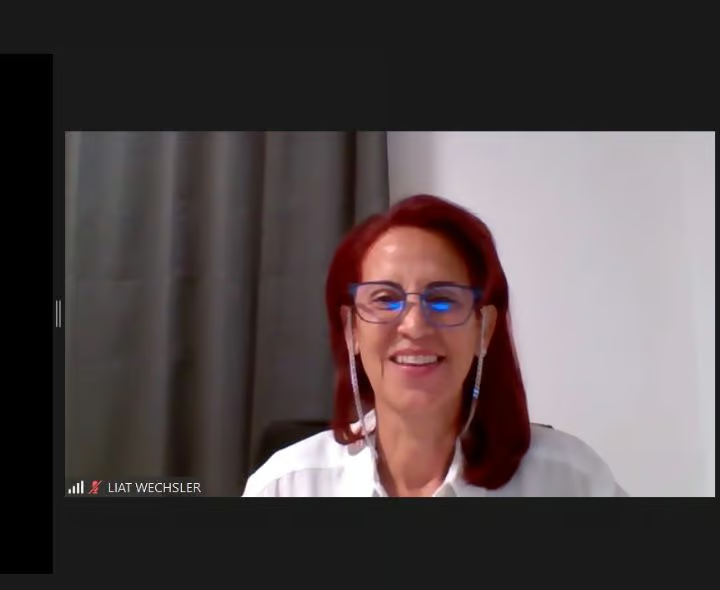
“The courses were in-depth, and I was also very impressed by the ability to conduct therapy on Zoom. The digital session provides more orderly boundaries and allows for extra effectiveness. When you meet on Zoom there are fewer reasons for cancellations and lateness.”
In summary
An online NLP course has many advantages, including fitting into the digital age and acquiring important technological skills, convenience for you and for your future clients, an intimate atmosphere and focus during the lessons. The experience of online therapy during your studies will make for a smooth transition into today's professional world of digital therapy. As a student, you can go through life-changing experiences in a process of self-discovery and empowerment like no other. As a professional NLP therapist, you will be able to offer effective support to people seeking personal growth and change, regardless of geographic location.
With its vast experience and commitment to excellence, Retter College offers tracks of NLP studies combined with guided imagery, including a comprehensive online format that brings out the many advantages of distance learning. We invite you to be part of the digital revolution and set out on a path of personal and professional fulfillment on a life-changing track.
Frequently asked questions:
What is the difference between an online NLP course and a digital NLP course?
This is a critical difference worth knowing:
Online NLP course: Live studies on Zoom with an instructor, much like a physical classroom. There is a fixed schedule, practice in pairs and support from assistants.
Digital NLP course: Self-paced learning by watching pre-recorded videos. There is no interaction, no feedback on your practice, and it is very hard to turn this knowledge into a profession. At Retter College we offer the live online (LIVE) track, which ensures commitment, a group experience and full professional certification.
How does an NLP course on Zoom work, and how do you practice the techniques?
Many people wonder about an NLP course on Zoom and the ability to practice. The platform lets us “split” the class into private practice rooms. In these rooms, each pair of students practices the techniques being taught, with close support from a team of assistants who move between the rooms, give feedback and fine-tune the process – exactly as happens in a physical classroom.
Can I complete NLP Master studies online?
Yes. We offer a full track that also includes online NLP Master studies. The academic level, the number of study hours and the certification requirements are completely identical to the in-person track, and the certificate awarded at the end of the studies is recognized by the international associations (such as the ABNLP).
Written and professionally reviewed by Daphna Retter

A co-founder of Retter College. She brought NLP to Israel in 1994 and has decades of clinical experience, having trained thousands of therapists. A certified member of the global GTC community through NLP University, she holds the rank of Certified Master Trainer of NLP from the ABNLP (view the certificate).